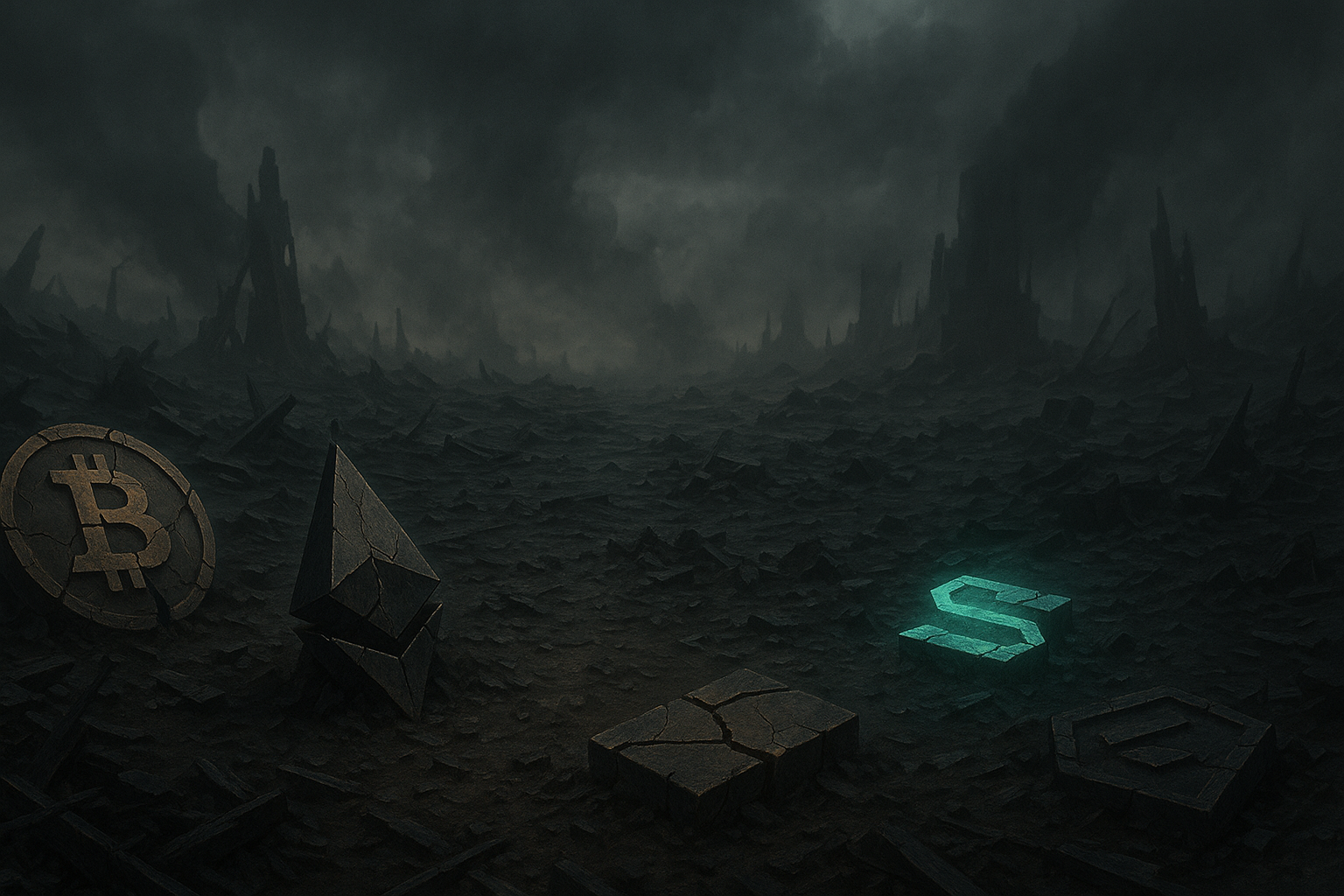
Remember when the blockchain world looked like a medieval battlefield — Ethereum knights dueling Solana speed demons while Cardano monks whispered about “academic rigor”? Ah, the good old days of crypto civil war. Each chain had its own cult, its own “we’re the future” manifesto, and its own army of Twitter trolls.
Fast-forward to 2025, and things look… different. The fires have cooled, the memes have aged, and developers have stopped threatening each other on X (well, mostly). The so-called Chain Wars — the great battle for blockchain dominance — are “over.”
Sort of.
Because while everyone’s now pretending to play nice, under the surface, the competition hasn’t died. It’s just evolved into something smarter, subtler, and far more corporate.
Let’s unpack how we got here, why it matters, and why your favorite chain might secretly be sleeping with the enemy.
1. The Golden Age of Blockchain Tribalism
Once upon a time, crypto Twitter was a war zone. Ethereum maxis mocked Solana outages, Solana fans bragged about speed, and Bitcoiners sat in the corner muttering, “None of this matters, we already won.”
Every project had a pitch:
- Ethereum: “We’re the OG — decentralized, secure, and definitely not a gas-fee nightmare.”
- Solana: “We’re faster than you, cheaper than you, and sometimes we even stay online.”
- Cardano: “We’re peer-reviewed, which totally makes us better.”
- Avalanche: “We’re basically Ethereum, but colder and shinier.”
And don’t forget the layer-2 skirmishes — Polygon, Arbitrum, Optimism — all screaming, “We’re scaling Ethereum!” while simultaneously trying to outdo it.
It was beautiful chaos. A digital Game of Thrones, if Westeros ran on smart contracts.

2. The Reality Check: Everyone Lost (and Won)
Here’s the twist: no chain “won” the war. Not Ethereum, not Solana, not the dozens of “Ethereum killers” that couldn’t even kill time properly.
Instead, what emerged was coexistence. Developers, exhausted from tribal battles, started asking a radical question: “What if… we just work together?”
Now, interoperability is the name of the game. Cross-chain bridges, multi-chain wallets, and shared liquidity protocols have replaced Twitter feuds.
In other words, the market decided collaboration was more profitable than war. A rare moment where capitalism actually encouraged peace — at least until the next funding round.
3. Ethereum Still Runs the Show (Mostly)
Let’s be honest — Ethereum didn’t win by being perfect. It won by being inevitable.
Like the internet’s TCP/IP, it became the default — the chain others had to connect to. Every major project now supports Ethereum compatibility because ignoring it is like building a smartphone without Wi-Fi.
Layer-2s like Arbitrum, Optimism, and Base are thriving. Each scales Ethereum differently, yet all funnel activity back to the same mother chain.
So yes, Ethereum’s still the sun in this galaxy. Everything else orbits around it — even the ones claiming independence.
4. Solana’s Redemption Arc
Remember when Solana kept crashing more than a Windows 98 laptop? Yeah, that era’s over.
Solana’s rebuilt its image — stable, fast, and now backed by serious institutional support. Payments, NFTs, DeFi — it’s all happening there, quietly and efficiently.
It’s the chain that went from “network down again?” to “Visa’s using us for settlement.” Talk about character development.
In the post-war world, Solana’s no longer trying to kill Ethereum — it’s just carving out a lane where it doesn’t have to apologize every time someone tries to send a transaction.
5. The Rise of the Pragmatic Builder
Before, being “multi-chain” was heresy. Pick a chain, swear loyalty, and prepare to die for it on Twitter.
Now? Every serious builder is multi-chain by design. Apps aren’t tied to a single ecosystem — they’re spreading across Ethereum, Solana, Cosmos, Avalanche, and even layer-2s.
Because here’s the truth: users don’t care what chain they’re on. They just want fast, cheap, and easy.
And developers finally realized: loyalty doesn’t pay bills — interoperability does.
6. The Corporate Peace Treaty
This part’s almost poetic. The same chains that once trash-talked each other now share investors.
Big VC firms like a16z, Sequoia, and Pantera have stakes across multiple ecosystems. When your investors are funding everyone, “winning” the war becomes bad business.
Now, CEOs from rival chains appear on panels together, smiling like divorced parents at a school play. They don’t love each other — they just love the money flowing in.
Make no mistake: this “peace” isn’t ideological. It’s financial. But in crypto, that’s good enough.
7. The New Battlefield: User Experience
If the Chain Wars were about ideology, the new conflict is about UX.
Nobody’s fighting over “which blockchain is best” anymore. They’re fighting over who can make it so users don’t even notice the blockchain at all.
Think of it like the internet — you don’t care which server your email runs on. You just care that it sends.
That’s the direction crypto’s finally heading: invisible chains powering seamless apps. Whoever nails that experience wins the next era.
8. The “Sort Of” Part
Of course, it wouldn’t be crypto if peace lasted too long.
The moment money’s involved, tribalism creeps back. The “Ethereum vs. Solana” flame wars still flare up whenever charts pump. Influencers still tweet “ETH is dead” for engagement.
So yes, the wars are “over” — but the soldiers are still lurking in the comments, sharpening their memes.
The tension never fully dies. It just waits for the next bull market to give it caffeine.
9. What This Means for You (a.k.a. The Sane Investor)
If you’re holding crypto, building, or just trying to make sense of it all, here’s the takeaway:
- Diversify across ecosystems. Betting on one chain is like betting on one browser in 2003.
- Follow the users, not the narratives. Chains rise where real adoption happens — not where influencers yell the loudest.
- Watch the bridges. Cross-chain infrastructure is where the next generation of innovation (and profits) lives.
And remember — in this new era, winners aren’t maximalists. They’re pragmatists.
10. Final Word: The End of Ideology (Mostly)
The Chain Wars gave us drama, memes, and enough tribal nonsense to fill an encyclopedia. But in the end, they taught us something valuable: tech doesn’t care about ideology. It cares about efficiency.
Ethereum, Solana, Avalanche — they’ve all matured, integrated, and adapted. The battlefield’s turned into a marketplace. And that’s progress, even if it’s less entertaining.
So yes, the wars are over. Sort of. The guns are down, the alliances are forming, and everyone’s pretending to get along.
But don’t be fooled — in crypto, peace is just the intermission before the next bull-run brawl.
The wars might be over, but the crypto evolution never stops.
If you want to stay ahead of the next wave — the real one — where innovation meets wit and hype meets honesty, keep reading CryptoCrate.org.
Because in this space, peace is temporary. But knowledge? That’s how you survive the next battle.

FAQs
Q1: What were the “Chain Wars”?
The Chain Wars refer to the intense competition between blockchain networks (like Ethereum, Solana, and Cardano) to become the dominant ecosystem for decentralized apps and users.
Q2: Is Ethereum still the leading blockchain?
Yes. Ethereum remains the dominant ecosystem for smart contracts and decentralized finance, supported by countless developers, protocols, and layer-2 networks.
Q3: Why did the blockchain wars end?
Because interoperability and investor overlap made direct competition less profitable. Collaboration became the smarter business model.
Q4: Is Solana still competing with Ethereum?
Not directly. Solana’s focusing on performance-heavy applications like payments and gaming while maintaining Ethereum compatibility through bridges and integrations.
Q5: What’s the next big frontier after the Chain Wars?
User experience. The next phase of crypto innovation is about making blockchain invisible — so seamless that users won’t even know what chain they’re using.
Leave a Reply