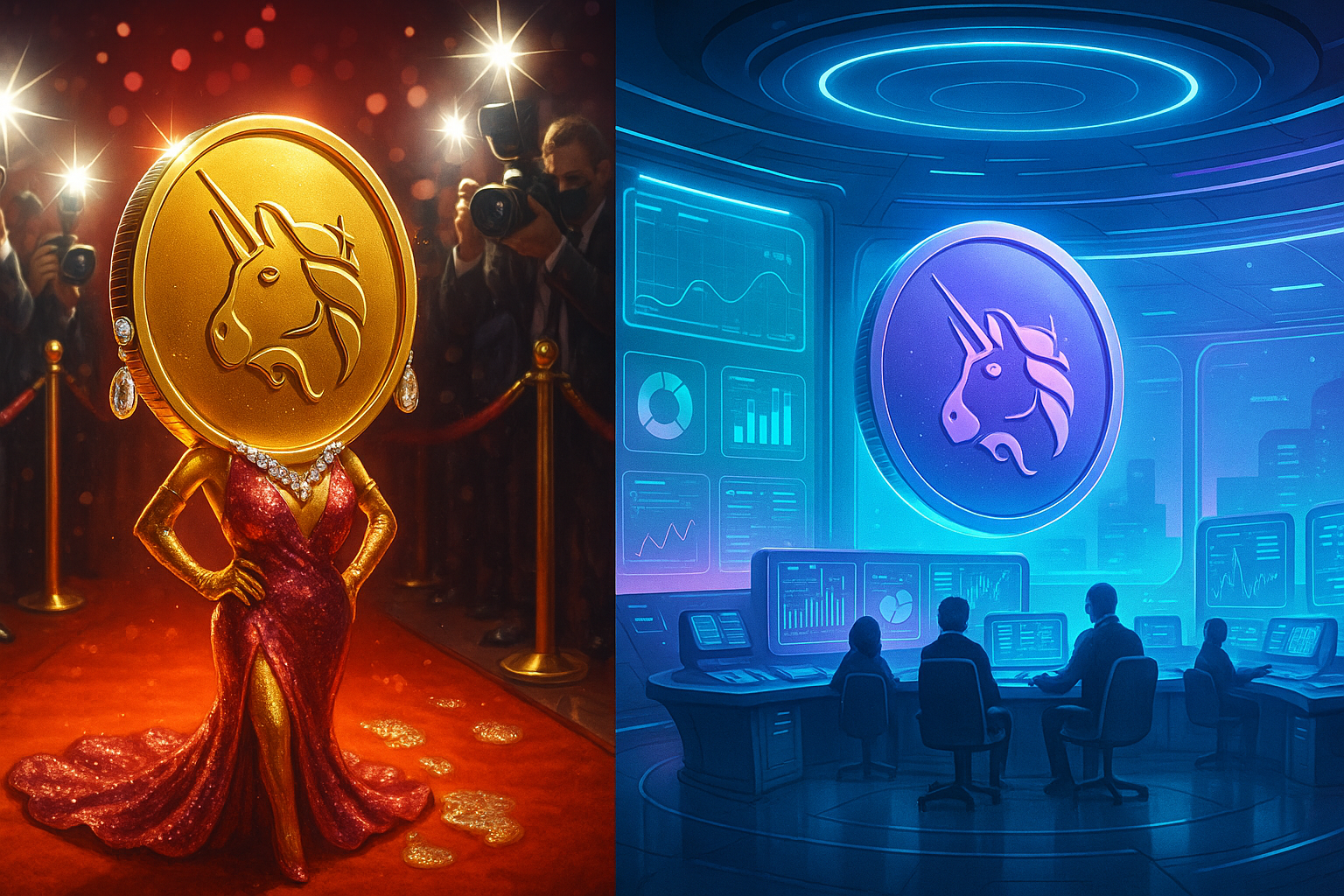
Did you ever think a software protocol would act more dramatic than your ex? Welcome to Uniswap, where tokens swap, liquidity pools bubble, and governance voters flex their muscles. But before you stake your life savings (or your pizza money) on UNI, let’s walk through the bright side, the dark side, and everything in between—explained simply, with sarcasm sprinkled on top.
Let’s be clear: Uniswap is a major decentralized exchange (DEX) built on Ethereum. It lets users trade ERC-20 tokens without middlemen, relying on liquidity providers and smart contracts for pricing. The UNI token gives holders voting rights over protocol upgrades.
But isn’t everyone doing that? Sure—but Uniswap was among the first. It has clout. And clout can be valuable in DeFi circles.
So here’s the game plan: first, five reasons yes, it might be worth investing. Then, five reasons uh-oh, tread carefully. Finally, my take (aka “Final Word”) where I urge you to buy or pivot—or at least laugh at the absurdity along the way.

5 Reasons to Consider Investing in UNI
1. Governance & Protocol Ownership (You Become the Voter, Not Just a Spectator)
UNI isn’t a token you just hold like a lottery ticket. It grants you a say in how the protocol evolves. Want Uniswap to support a new blockchain? Want to tweak fee structures? UNI holders vote. In a world where control is wealth, owning governance is owning power. That’s not hype—it’s structural value.
2. Dominance in DEX Volume & Brand Recognition
Uniswap is a name even your grandma has heard (if grandma is into crypto). It’s one of the leading DEXs for Ethereum tokens, known for reliability, familiarity, and utility.
Volume begets liquidity, which begets more adoption. Like a snowball rolling downhill—except with transaction fees.
3. New Tech: Uniswap v4, Hooks, & Gas Optimizations
Uniswap v4 deployed in early 2025 across multiple chains introduces “hooks” (custom logic attachments) and claims gas cost reductions of over 99% via flash accounting and singleton architecture.
If that works as advertised, UNI’s utility could jump—they’ll be not just a DEX but a programmable, efficient liquidity engine.
4. Ecosystem Effects & Cross-Chain Ambitions
Although Uniswap is rooted in Ethereum, it’s not staying a one-chain diva forever. Bridging, cross-chain swaps, and broader integrations are in motion.
If UNI becomes central to multi-chain liquidity infrastructure, then the demand for governance and utility could rise sharply.
As Uniswap collects swap fees, it has a revenue stream. Some announcements highlight in-app bridging and token burns or revenue allocation strategies as possible reward mechanisms.
Plus, Uniswap is powering real activity: swapping, DeFi usage, new token launches—even though that means it risks being abused. But actual use = real demand, not just speculative hype.
5 Reasons to Be Cautious (or Hide Under the Table)
1. Gas Fees & Ethereum Congestion (UNI’s Achilles’ Heel)
Uniswap lives on Ethereum, and Ethereum’s traffic jams are legendary. Each trade costs “gas,” sometimes more than your snack budget. High gas can kill marginal trades and discourage casual users.
If rollups, layer 2s, or scaling upgrades don’t deliver, UNI’s user growth may stall.
If you provide liquidity (LP) to pools, you risk impermanent loss—the divergence between holding tokens separately vs pooling them. Over time, that loss could outweigh the fees you earn.
Many new DeFi users (or kids) see “earn fees” but ignore the math. That’s the trap.
3. Smart Contract Risk & Governance Missteps
Smart contracts are code, and code can have bugs or exploits. Uniswap v2 had known “static errors” and vulnerabilities.
Moreover, governance proposals sometimes risk centralization or regulatory exposure. For example, a proposal to let governance elect the Uniswap Foundation’s board raised concerns over pressuring legal liability.
One bad upgrade could haunt UNI holders for years.
4. Regulatory Threat: SEC & DeFi Uncertainty
Uniswap Labs has already received a Wells notice from the SEC (i.e., “we might sue you”) over possible securities law violations.
Since UNI holders benefit from revenue and governance, regulators might argue it’s an investment contract. That’s a political minefield. One wrong ruling, and UNI could become a restricted asset in major jurisdictions.
5. Scams, Rug Pulls & Token Pollution
Because Uniswap is permissionless, anyone can list a token—even rug pulls or malware-laden contracts. Some analysts suggest a large fraction of tokens trading on Uniswap are scams. Even if UNI itself doesn’t fail, ecosystem reputation risk is real. Uniswap’s brand might be tainted by bad actors using its tech.
Deep Dive: How Uniswap Works (Simplified, So Even a Kid Can Follow)
(Yes, I promised simple. I delivered.)
The Lemonade Stand Analogy
Imagine a lemonade stand run by a group of kids. People can buy lemonade (token A) and pay with soda (token B). The pricing adjusts automatically based on how much lemonade or soda is in the jars. That’s automated market making (AMM).
Uniswap is that stand—with code doing the math. The jars = liquidity pools; adding lemonade + soda = providing liquidity; each swap = someone exchanging one token for another.
If more lemonade is taken out than soda added, lemonade becomes more valuable relative to soda. The pricing shifts automatically, no humans yelling “hey, adjust it!”
UNI Token = Club Membership Card
You hold UNI → you vote on changes (e.g. “Should we allow 0.3% fees instead of 0.25%?”). You propose ideas. You influence the future.
Even if you don’t vote, your UNI is like a badge—you’re part of the club. That gives psychological weight. People want to be in the club.
Hooks & Smart Enhancements in v4
Uniswap v4 lets developers attach “hooks” (custom logic) to pools—like dynamic fees or cooldowns. It’s like giving your lemonade stand a feature: “If it’s hot, charge extra. If it’s afternoon, use a discount button.”
Also, v4 claims fancy gas-saving tricks—so trades cost less. If that works, many more people might join because fees shrink.
Price Outlook & Forecast Thinking (But Don’t Treat It Like Gospel)
Forecasts are mostly guesses with estimations. But here’s what analysts are saying:
- Changelly: UNI may trade between $8.78 and $11.79 in 2025.
- CoinCodex: possible gains of ~70% from current levels.
- Cryptopolitan: long-term forecasts like $34.48 by 2027, and even $70+ by 2031 under bullish assumptions.
- Benzinga: sees UNI at $22.82 by 2030 in a strong scenario.
But note: these depend on broad DeFi growth, regulatory tailwinds, adoption scaling, and tech execution. One failure in security, one harsh regulation, and forecasts could be scrubbed clean like chalk on a blackboard.
Strategy Suggestions (Because I’m Nice Like That)
- Start small. Don’t bet the farm. Let UNI be a splash, not the entire portfolio.
- Stay liquid. Always keep some funds aside. When gas prices dip or hooks feature launches, you’ll want to pounce.
- Vote or delegate. Use your governance rights. Even if you don’t plan to lead, delegating to trustworthy community members gives you a voice without responsibility.
- Watch release schedules and upgrades. Token emissions, v4 adoption, governance proposals — these are catalyst triggers.
- Diversify across DeFi. Even if UNI does well, staking or holding only UNI is risky. Don’t ignore other protocols or layers.

Final Word
Uniswap (UNI) is both promising and precarious. It has the right ingredients: governance power, deep DeFi integration, evolving tech, and ecosystem momentum. But it also carries real risks: regulatory storms, contract bugs, high gas fees, and corporate scrutiny.
If you invest, do it with eyes wide open. Expect volatility. Expect headlines that alternate between “UNI to the moon!” and “SEC sues DEX!” But also expect the possibility that UNI ends up a foundational protocol in Web3’s financial infrastructure.
Would I put money in it? Yes, but cautiously—and with the mindset that this isn’t a get-rich-quick scheme. It’s more like buying stock in a tech startup: you believe in the vision, but understand the bumps.
So go ahead—step into the Uniswap pool if you dare. But don’t forget your lifejacket.
TL;DR: UNI gives you votes, exposure, and innovation potential—but also headline risk, gas headaches, and legal ambiguity. It might flourish, or it might get dragged into courtroom drama. Either way, it’s going to be entertaining.
Ready to Stop Guessing and Start Understanding?
If you’re tired of crypto hype that sounds like a pyramid scheme disguised as financial advice, head to CryptoCrate.org. We break down real projects, market moves, and trends — no cult chants, no moon emojis, just straight talk with a sharp edge. Think of it as financial clarity… with better punchlines.
Leave a Reply